
Industrial drill bits have played a transformative role in the development of modern energy, construction, and mining industries. From the early days of steel-tooth cutters to the advanced synthetic diamond PDC (Polycrystalline Diamond Compact) bits used today, drill bit innovation has significantly impacted how we explore the earth and extract resources efficiently. This guide explores the complete evolution of industrial drill bits and the technologies that changed the face of drilling.
Drilling Challenges That Drove Innovation
Geological and Technical Barriers
In the early days of drilling, operations faced extreme friction, tool failure, and low penetration rates in hard formations. These challenges slowed progress, increased cost, and led to frequent interruptions.
Need for Speed and Precision
The demand for faster, more efficient drilling—especially in shale plays and deep wells—required technology that could cut rock with less weight on bit and fewer failures.
Shift Toward Cost Per Foot Efficiency
Operators began evaluating bit performance not just by rate of penetration (ROP), but by cost per foot drilled, total rig time, and durability across lithology transitions.
Ancient Beginnings to Early Industry
Steel-Tooth Roller Cone Bits in the Early 1900s
The first major industrial leap in drill bits came with steel-tooth roller cone designs. These bits mechanically crushed rock using rotating cones fitted with metal teeth.
Hughes Two-Cone Bit Patent (1909)
Howard Hughes Sr. revolutionized drilling with the two-cone bit, which dramatically improved penetration rates and became the industry standard.
Rise of Tricone Roller Bits
By the 1930s, tricone bits offered more balance and durability. These became the workhorse of the oil industry for decades and introduced carbide-tipped teeth for better wear resistance.

Material Innovation and the Limits of Mechanical Cutting
Tungsten Carbide Inserts
In the mid-20th century, tungsten carbide inserts replaced steel teeth for increased hardness and longevity, especially in abrasive formations.
Mechanical Cutting vs Shearing Action
Roller cone bits crush rock, while newer technologies aimed to shear it. Shearing requires less weight and energy, setting the stage for PDC innovation.
The Rise of Polycrystalline Diamond Compact (PDC) Drill Bits
What Is a PDC Cutter?
A PDC cutter consists of synthetic diamond crystals sintered with tungsten carbide. These cutters are brazed onto a solid bit body and shear through rock with unmatched efficiency.
GE and the Invention of PDC (1970s)
GE pioneered synthetic diamond cutters in the 1970s, originally for wear-resistant surfaces. Engineers soon adapted them into drill bits, giving birth to the fixed cutter PDC bit.
Advantages Over Roller Cones
PDC bits have no moving parts, reducing wear and mechanical failure. Their shearing action results in faster rates of penetration (ROP) and smoother boreholes.
PDC Drill Bit Design Advancements
Matrix vs Steel Body Bits
Matrix bodies offer erosion resistance and support complex designs. Steel bodies provide toughness and higher impact strength, suitable for interbedded formations.
Blade Count and Cutter Geometry
Blade spacing, back rake angles, and cutter exposure are carefully engineered for maximum efficiency. More blades typically improve durability but can reduce ROP.
Thermal Stability and Hybrid Bits
Thermally Stable Polycrystalline (TSP) diamonds and hybrid designs extend bit life in high-temperature environments.
Digital Design Tools
Modern PDC bits are developed using CFD (computational fluid dynamics), FEA (finite element analysis), and 3D modeling to optimize fluid flow, durability, and performance.
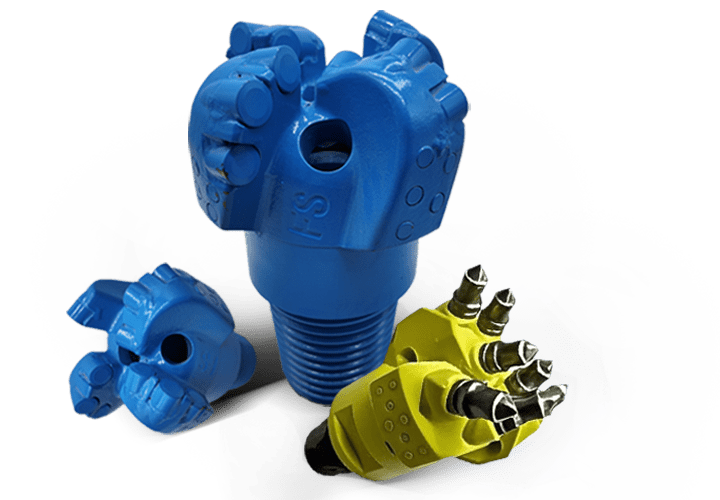
PDC Cutter Types and Their Applications
Standard vs. Leached Cutters
Leached PDC cutters remove the metallic binder from the diamond surface, enhancing thermal stability and abrasion resistance in hard, hot formations.
Chisel, Dome, and Conic Shapes
Different geometries are optimized for impact resistance, ROP, and rock interface. For example, chisel cutters improve aggressiveness, while dome shapes resist fracture.
Thermally Stable PDC (TSP)
TSP materials are designed to retain crystal structure at high temperatures, making them ideal for deep geothermal wells or hard rock mining.
How PDC Drill Bits Are Manufactured
Diamond Sintering Process
PDC cutters are produced by sintering synthetic diamond powder onto a tungsten carbide substrate under extreme temperature and pressure (above 1,400°C / 2,552°F and 50,000+ psi).
Bit Body Fabrication
Bit bodies are made either from steel or tungsten-carbide matrix, depending on the application. Matrix bits are better in abrasive zones, while steel bodies handle impact better.
Cutter Brazing and Quality Control
Cutters are brazed into blades with precise orientation. Bits then undergo rigorous lab testing—impact testing, abrasion resistance, cutter retention, and field simulation.
Real-World Impact of PDC Bits
Improved Drilling Efficiency
PDC bits can double or triple the ROP compared to roller cones, especially in shale or soft-to-medium formations.
Reduced Drilling Costs
With fewer trips needed to change bits, PDC technology lowers cost per foot and total well time.
Better Hole Quality
The continuous shearing action of PDC bits results in cleaner, more stable boreholes.
PDC Applications Across Industries
Oil & Gas
Used in directional and horizontal wells, PDC bits are standard in shale, sandstone, and carbonate drilling.
Geothermal Drilling
Withstanding extreme heat and hard formations, PDC bits have become reliable tools for geothermal well construction.
Mining and Civil Construction
PDC bits are used for raise boring, tunneling, and foundation drilling where precision and durability are critical.
Related Reading: The Ultimate Guide to Drill Bit for Mining
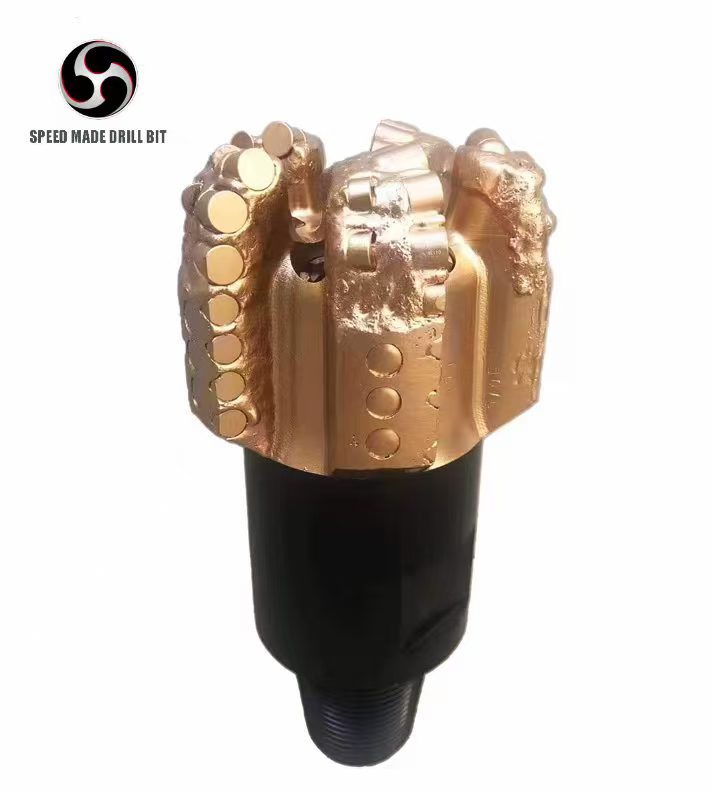
Comparison: PDC vs. Roller Cone vs. TSP vs. Hybrid Bits
| Bit Type | Cutting Mechanism | Best For | Advantages | Limitations |
| PDC | Shearing with synthetic diamond | Shale, sandstone, carbonates | High ROP, long life, fewer trips | Prone to impact in interbedded rock |
| Roller Cone | Crushing with rotating teeth | Complex lithologies | Tolerates transition zones | Slower, wears quickly |
| TSP | Shearing with thermally stable diamond | Geothermal, deep wells | High-temp durability | Costly and fragile |
| Hybrid | Combination of PDC + rolling cutters | Interbedded zones | Balance of speed and toughness | Complex, more expensive |
Related Reading: What is the difference between PDC and rock bit?
Future Trends in Drill Bit Technology
Nanocomposite Diamond Materials
Next-gen PDC bits will feature nano-diamond composites offering enhanced thermal conductivity and hardness.
Smart Drill Bits
Emerging bits may include sensors for real-time wear monitoring, vibration feedback, and downhole analytics.
AI-Powered Design and Bit Selection
AI-driven systems are being tested to auto-match bits to lithology data, reducing operator guesswork and improving drilling performance.
FAQs About Industrial Drill Bits
What’s the Difference Between PDC and Roller Cone Bits?
PDC bits shear rock with fixed synthetic cutters, while roller cones crush rock using rotating steel/carbide teeth.
Why Are PDC Bits Preferred in Shale?
They offer faster penetration, longer life, and better borehole quality in uniform shale formations.
How Are PDC Cutters Made?
By sintering synthetic diamond crystals onto tungsten carbide at high pressure and temperature.
Conclusion
From steel-tooth rollers to synthetic diamond PDC bits, industrial drill bits have evolved through breakthroughs in design, materials, and computational modeling. Understanding this history helps engineers and operators choose the right bit and stay ahead in a high-stakes industry where performance and precision are everything.